Blog

How the Technological Design of Facebook Homogenizes Identity and Limits Personal Representation

by Benjamin Grosser

Download the paper (PDF)

Note: this paper was published in Hz #19 in 2014. Please cite that version.
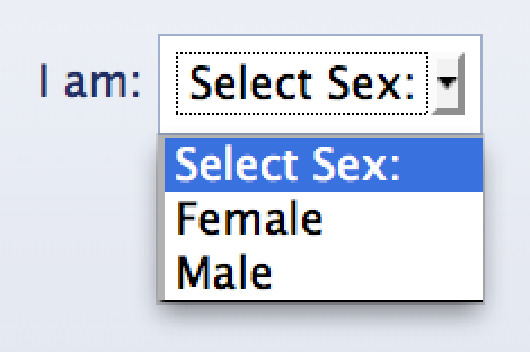
The Facebook gender choice dropdown on their new account signup page.

Abstract

This paper explores how the technological design of Facebook homogenizes identity and limits personal representation. I look at how that homogenization transforms individuals into instruments of capital, and enforces digital gates that segregate users along racial boundaries. Using a software studies methodology that considers the design of the underlying software system, I examine how the use of finite lists and links for personal details limits self-description. In what ways the system controls one’s visual presentation of self identity is analyzed in terms of its relation to the new digital economy. I also explore the creative ways that users resist the limitations Facebook imposes, as well as theorize how technological changes to the system could relax its homogenizing and limiting effects.
Introduction

Ever since its inception, people have used the technology of the Internet to represent themselves to the world. Sometimes this representation is a construction based on who they are outside the network, such as with a personal webpage or blog. Other times people use the built-in anonymity of the Internet to explore and engage alternative identities. This identity tourism (Nakamura, 2002) takes place within game spaces (e.g. MUDs, MMORPGs), chat rooms, or forums, as well as within those spaces already mentioned such as webpages and blogs. In each case, the underlying technology that facilitates this network society of digital representations is software. How this software is designed by its creators determines the ways that users can (and cannot) craft their online representation.

The most popular network space for personal representation is Facebook, the world’s largest online social network. The site has more than 500 million active users and has become the most visited website in the United States, beating out Google for the first time in 2010 (Cashmore, 2010). Facebook functions as a prime example of what Henry Jenkins (2006) calls “participatory culture,” a locus of media convergence where consumers of media no longer only consume it, but also act as its producers. Corporations, musicians, religious organizations, and clubs create Facebook Pages, while individuals sign up and fill out their personal profiles. The information that organizations and people choose to share on Facebook shapes their online identity. How those Pages and profiles look and the information they contain is determined by the design of the software system that supports them. How that software functions is the result of decisions made by programmers and leaders within the company behind the website.

This paper explores how the technological design of Facebook homogenizes identity and limits personal representation. I look at how that homogenization transforms individuals into instruments of capital, and enforces digital gates that segregate users along racial boundaries (Watkins, 2009). Using a software studies methodology that considers the design of the underlying software system (Manovich, 2008), I look at how the use of finite lists and links for personal details limits self-description. In what ways the system controls one’s visual presentation of self identity is analyzed in terms of its relation to the new digital economy. I also explore the creative ways that users resist the limitations Facebook imposes, as well as theorize how technological changes to the system could relax its homogenizing and limiting effects.
Continue reading

News Coverage of Interactive Robotic Painting Machine

Interactive Robotic Painting Machine on the Front Page of Engadget

After I posted a page about my Interactive Robotic Painting Machine about ten days ago, it received coverage by a number of high-profile blogs, including Boing Boing, Engadget, and Make. I was interviewed for a new syndicated news show called “Right This Minute” (I’ll blog more details about the air date when I know), Twitter was bouncing with links to the project, and my short video received more than 35,000 plays. It has been quite a week! I appreciate all the interest, emails, and questions that everyone has sent my way.

An incomplete list of coverage around the ‘net:

Personal Depersonalization System Covered By News-Gazette

From the 'Art and About' blog on News-Gazette.com

Melissa Merli, arts writer for the News-Gazette, wrote about my new work Personal Depersonalization System on her Art and About blog. The article, titled “Figure One show looks at knowledge acquisition and subverting Google”, explores the piece at length. Calling my work “one of the most relevant or timely pieces,” Merli asks about my attempts to depersonalize my Google profile: “Can Ben run? Can he hide?”

The group show this article is about, Accepted Knowing, is on view at Figure One through August 26, 2011.

Related Content:

Personal Depersonalization System at Figure One in August

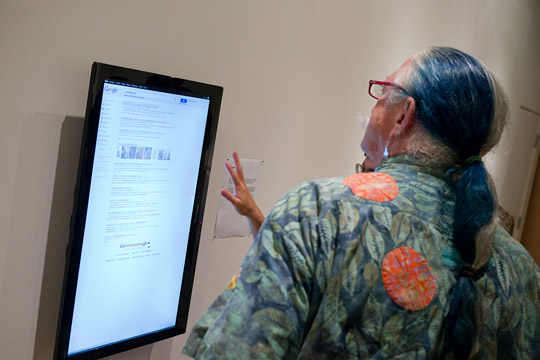
Patch Adams checking out Personal Depersonalization System at Figure One

My new work ‘Personal Depersonalization System’ is on view in August at Figure One in Downtown Champaign, IL. The work is part of a show titled ‘Accepted Knowing: Peer Review’, curated by Nicki Werner, Maria Lux, and Jeanie Austin. The space is open on Tuesdays from 12-5p and Thursdays from 5-9p until the closing reception on August 26, from 6-9p. If you have a chance, I highly recommend the show.

Recording of Shift for Six Udderbots

Jacob Barton
photograph by Chris Marolf

On January 19, 2011, Jacob Barton performed the world premiere of my musical work titled Shift (2010), at the Contemporary Arts Center of Virginia in Virginia Beach, VA. Barton is the world’s premiere Udderbot virtuoso, and Shift is written for one live udderbot and five recorded udderbots.

Shift was originally an unfinished composition of mine for large chamber ensemble, but I rewrote it for six udderbots when Jacob commissioned a new piece from me last fall. The score provided him with rhythms and pitch cluster choices, but doesn’t specify specific pitches. Thus Jacob made those choices from the given material and wrote out a final score. Because the work is for six udderbots and Jacob is only one, he recorded five of the parts on tape and then plays the final part live with the tape during performance.

Related Links:

Interactive Robotic Painting Machine’s Works

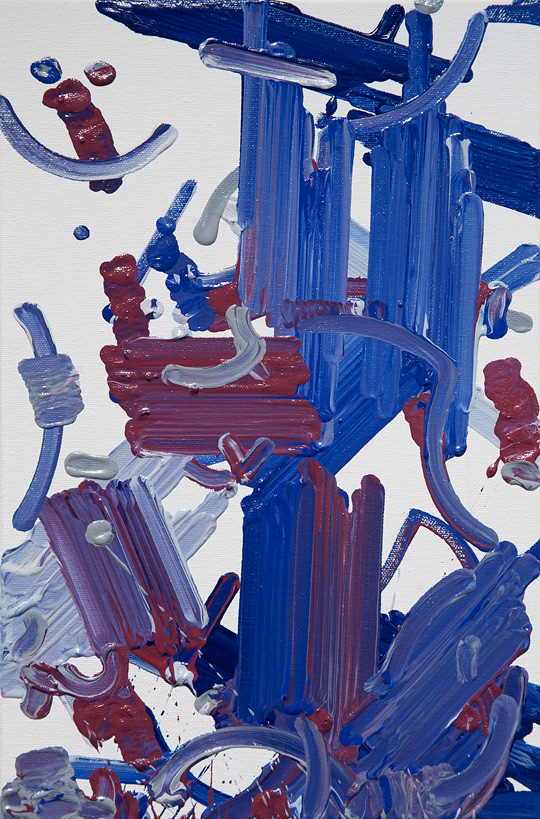
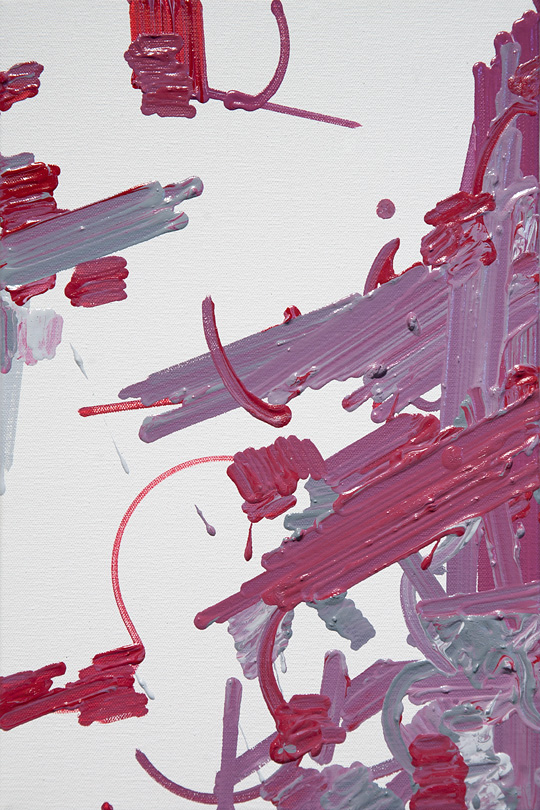
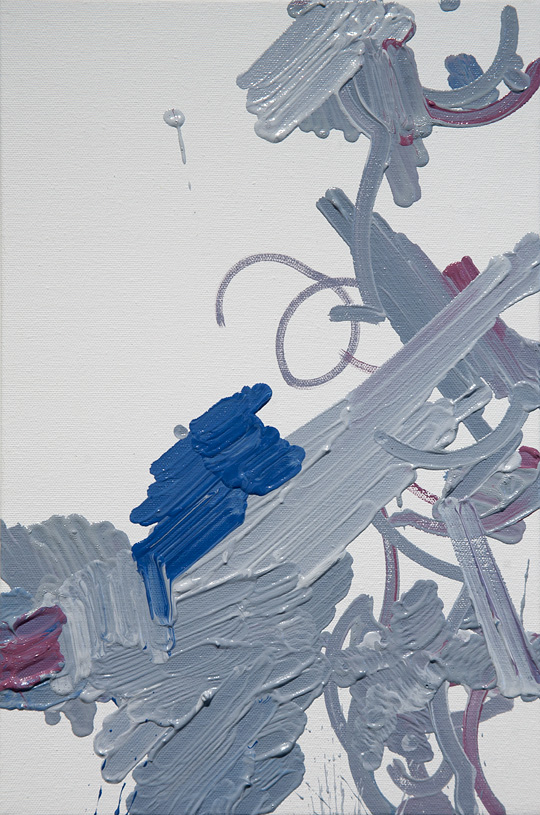
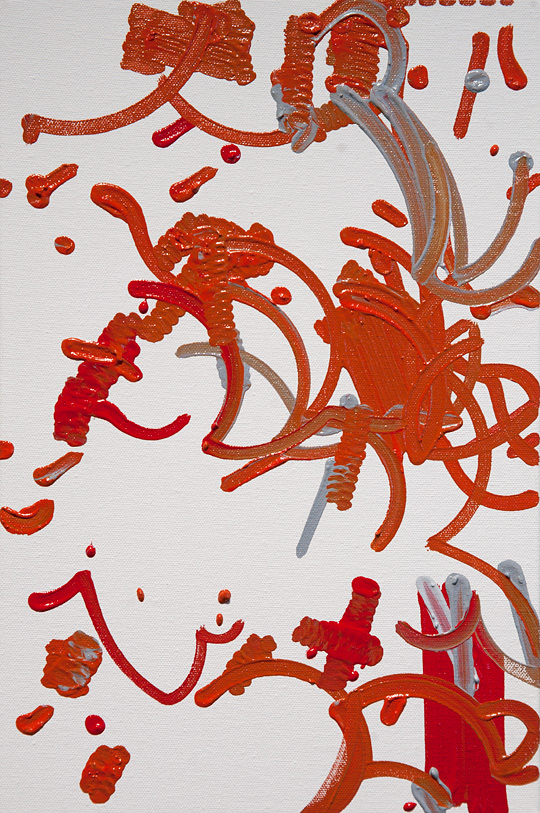
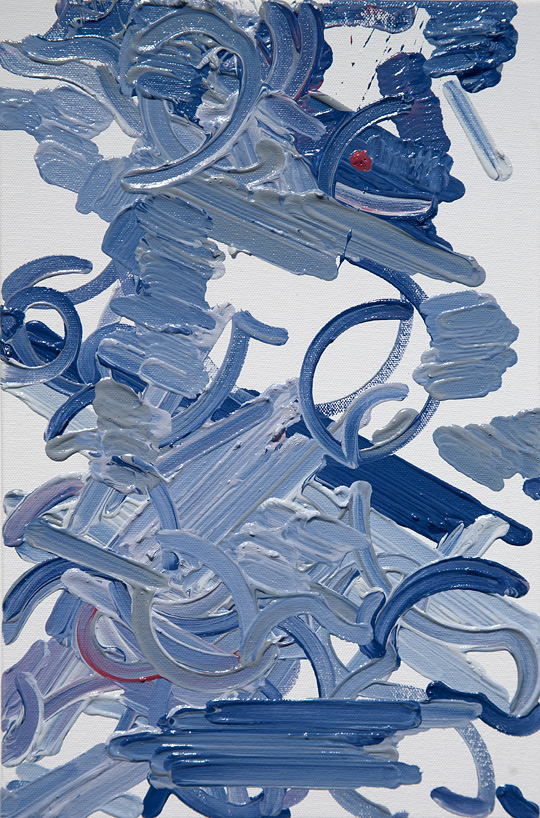
In preparation for its debut performance this Tuesday, I’m posting a few works by my interactive robotic painting machine. The machine takes about 70 minutes to paint these works, while the performance will only run 10-15 minutes. As such, the machine will be painting quite a bit smaller in order to make it within that timeframe. More soon…

Painting by Interactive Robotic Painting Machine (2011)
oil on canvas, 15x10"

Painting by Interactive Robotic Painting Machine (2011)
oil on canvas, 15x10"

Painting by Interactive Robotic Painting Machine (2011)
oil on canvas, 15x10"

Painting by Interactive Robotic Painting Machine (2011)
oil on canvas, 15x10"

Painting by Interactive Robotic Painting Machine (2011)
oil on canvas, 15x10"

Interactive Robotic Painting Machine Makes Debut

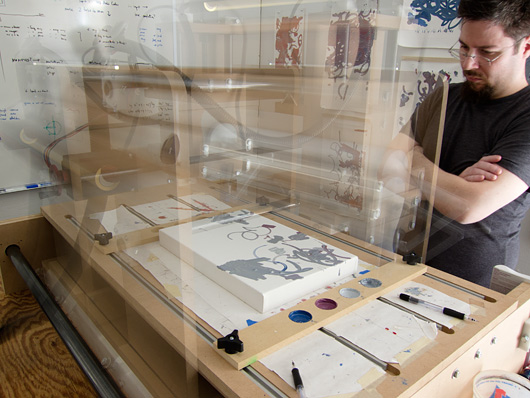
On April 26, my interactive robotic painting machine will make its public debut at the Krannert Center for the Performing Arts in Urbana, IL, 7:30p. The result of over a year’s worth of work, the machine uses artificial intelligence to paint its own body of work and to make its own decisions. It also listens to its environment and considers what it hears as input into the painting process.

Watching my interactive robotic painting machine make a painting. ~3 second exposure.

So why is this first appearing at a performing arts center? Because it will appear in a collaborative work between myself and composer Zack Browning, titled Head Swap. Head Swap is a work for amplified violin and interactive robotic painting machine that will mix music, art, and robotics into one multidisciplinary performance. The machine will paint a painting during the piece, using what it hears to help it evaluate what it makes. The violinist, Benjamin Sung, will play Browning’s music by using what he sees the machine paint as guidance through the score. The machine also functions as a musical instrument itself, feeding pitched chords (dyads usually) back into the work.

There will be two other, older collaborations between Zack and myself on the concert. Back in the ’90s, I wrote a sound synthesis software package called GACSS, that both Zack and I used for our work. Zack will have two pieces on this concert for instrument and computer-generated sound that utilize the software I wrote. This was a fruitful collaboration that produced a lot of rocking music!

I’ll be posting lots of documentation of the robotics project over the next month or so, but if you’re in town, please come by and check out the concert.

Related Content:

Variable Mirror at Anka Gallery in April

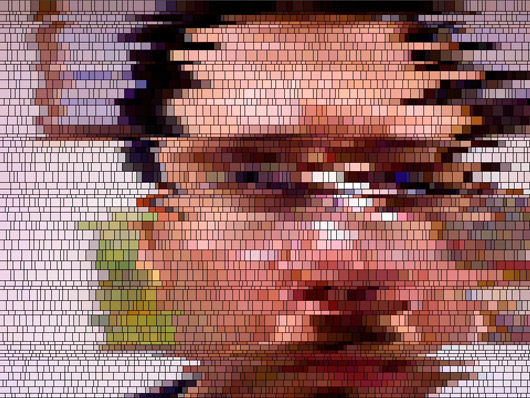
My work Variable Mirror (2009) has been accepted into the PXL show at the Anka Gallery in Portland, Oregon. The PXL show is about work that explores the impact of the pixel on the world. Variable Mirror is part of my Flexible Pixels Project.

still image capture from Variable Mirror (2009)

During the opening reception of the show, a presentation will be given (and webcast) by Russell Kirsch. Kirsch is considered to be one of the founders of digital imaging, and is credited with having created the first digital image in 1957. Having originally crafted the pixel as inherently square, Kirsch now believes that pixels should be variable in shape. He will present a new technique for doing so.

I look forward to seeing what he’s working on. My Flexible Pixels Project is constructed in response to the current fixed shape and use of the pixel. My works in this project explore what happens if you break the rules of the pixel and allow them to vary in size, shape, and arrangement. While Kirsch and I are are after quite different goals, he’s the first person I’ve heard other than myself talk about this notion of variable pixels. And who would have expected it would be from the person who created the pixel in the first place?

The show is open from April 7 through April 29th, with a First Thursday opening (and presentation by Kirsch) on April 7 from 6-9p, and an Open House reception on April 21 from 4-7p.

Speed of Reality at Co-Prosperity Sphere

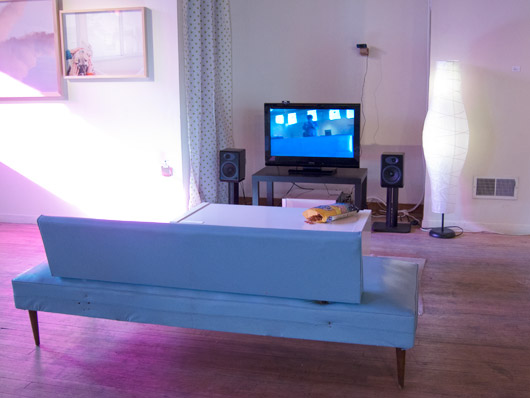
My installation work titled Speed of Reality is part of a group show in Chicago titled Artsplosia. Artsplosia presents the work of the MFA students at the University of Illinois. Twenty-two artists in addition to myself are presenting work that varies in media from painting to sculpture, drawing to new media.

installation shot of Speed of Reality at Co-Prosperity Sphere in Chicago

The show opened at Co-Prosperity Sphere, 3219 S. Morgan St., Chicago, on March 26 and runs through April 2. There will be a closing reception on April 1 at 6p. I will be there, so stop by if you’re in town!

What Are Art/Music Machines For?

When I started working with computer music around 1990, the technology was quite different than what we have available today. Computers didn’t come with sound cards, there was no SuperCollider or Max/MSP, and disk space to store created sounds was extremely limited. To engage with the medium, I got my start working in the UIUC Computer Music Project, a lab which provided a home-built digital-to-audio converter (DAC), and a Music-V type language to work with called Music 4C. I authored (coded) various instruments for Music 4C and used them to create new works.

Make Something New

Some of my colleagues at the time focused their efforts on recreating existing instruments. They wanted an “accurate” string sound, or a pretty trumpet or clarinet timbre to come out of the speakers.

I never understood this.

If they wanted a pretty trumpet, clarinet, or violin, the floor below us was full of musicians proficient with those instruments practicing to get better every day. They could just ask one or more of them to play their piece.

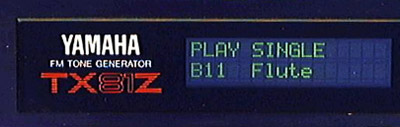
A Yamaha TX81Z synthesizer ready to crank out the cheesy flute sounds

Given the potential of a new medium to make new sound, why try to reproduce the old? I wanted my software to make sounds I had never heard before—that nobody had ever heard before. This might sound like a tall order, but this is precisely what the world had already gotten over and over with each new instrument invented. Computer music was just another new instrument, but a flexible one that could facilitate the invention of many new instruments. It was an opportunity to break the rules of physics, not to adhere to them!

MIDI Fills The Planet With Crap

Then there were those that chose to focus their attention on MIDI synthesizers. While there were one or two needs I saw MIDI as useful for, mostly it seemed to be filling the planet with more crap. MIDI was nothing but canned sounds trying to imitate physical instruments, but failing miserably. Their reproductions lacked the timbral complexity of the original. In other words, MIDI took what was interesting about sound and destroyed it.

Eventually I focused my energies on the creation of GACSS, a software package that allowed myself and others to easily create and compose with (previously unheard of) new sounds. Over the years MIDI continued to flourish and still dominates today. However, composers have new tools such as Max/MSP that make it easy to create new sounds without any difficult programming, so now there’s really no excuse not to make your own thing.

What Should a Painting Machine Make?

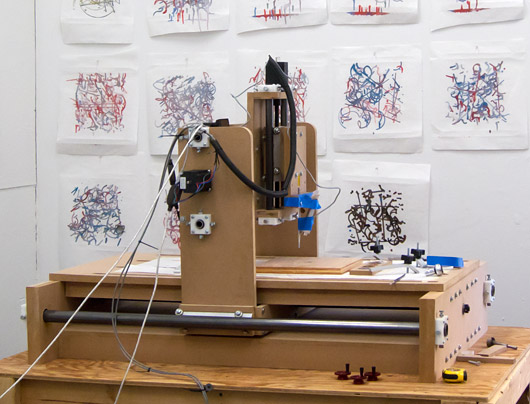
My collaborative robotic painting machine (very much still in progress). Paintings on the wall behind it are a few of its first sketches.

Fast forward to now, and one of my current projects is a collaborative robotic painting machine. This machine will develop its own body of work, accept and consider input from others, and will use that input to create both paintings and music. There are a number of painting machines out in the world that people have created. But what’s driving me nuts, twenty years after I started down this road, is that these new painting machines are typically painting paintings that already exist or that the artist can already create themselves.

Perhaps the best known painting machine is Harold Cohen’s AARON. While it’s really just software these days (no hardware component), his goal for the machine is for it to paint paintings like Harold Cohen paints paintings. It’s an interesting technical problem, but why? Harold Cohen can already paint like Harold Cohen! Unquestionably there’s an interesting element there in seeing how the computer does it differently than Harold. But I ask the same question now that I asked before: why not use the machine to create something we haven’t seen?

I want to create machines that make things I haven’t yet seen or heard. To do so, I exploit those areas where the machine excels—and the humans don’t. In the case of a painting machine, the system is a lot better with qualities like repetition, accuracy, and endurance than I am. I can use these technological advantages to my benefit, while treating those things I’m better at (such as quick pattern recognition) as system constraints. Ideally, the result will be a new creation, something that could not have existed otherwise. But no matter what, I know it won’t be something I saw or heard last month, last year, or from all of history. And that means I have something to look forward to.