Blog

Commentary in Big Data & Society Discusses How Tracing You Reveals Desire for Visibility

I discuss reactions to Tracing You in the latest issue of Big Data & Society

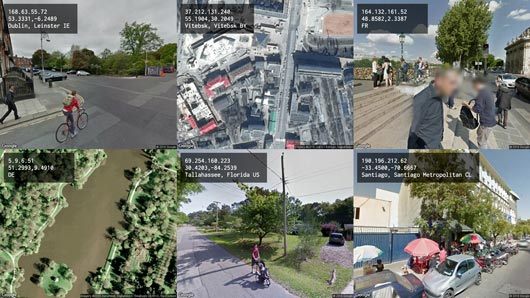
I have a commentary in the latest issue of the journal Big Data & Society. The text, titled “Tracing You: How transparent surveillance reveals a desire for visibility,” examines feedback to my computational surveillance work Tracing You. I argue that reactions to the work—in particular those who are angry Tracing You isn’t more accurate than it is—reveal how we’ve become conditioned to expect surveillance. Why?:

One answer lies in “Web 2.0’s” (O’Reilly, 2005) insistence on radical transparency. Social media in particular has conditioned many to not only accept high visibility, but to desire it (Bucher, 2012: 1175). This is because being as visible as possible on sites like Facebook and Twitter is the key that permits entry into and full participation within those site’s systems of interaction and connection. Users can lurk or hide if they choose, but doing so severely limits user experience. When this desire for visibility intersects with ubiquitous transparent veillance, it contributes not only to an acceptance of being seen, but also helps to produce the negative emotions expressed by users less visible to surveillance systems. Being less visible within social networks means having less power; one’s power (to influence opinion, to increase friend networks, etc.) is dependent on one’s visibility.

As a result, many visitors to Tracing You have already been conditioned by social networks to equate visibility with power. Thus, by mirroring the veillant structures of sites like Facebook, Tracing You also produces—at least for some of its visitors—a similar desire for visibility. This happens despite the overt potentially negative surveillance implications proposed by Tracing You’s ability to reveal one’s physical location.

You can read the full text here. The piece is part of a special issue titled “Veillance and Transparency: A Critical Examination of Mutual Watching in the Post-Snowden, Big Data Era,” edited by Vian Bakir, Martina Feilzer and Andrew McStay.

Interview with CBC Radio About Go Rando

Spin the wheel of Facebook emotional reactions! (image by Michelle Parise of CBC)

I had a great time talking with Nora Young of CBC Radio about Go Rando and the effects of emotional surveillance on Facebook. The show it’s part of, called Spark “…explores how technology, innovation and design affects our lives.”

To listen, click play above, go to the segment’s page on the CBC site, or download the full episode it’s a part of as a podcast.

Facebook Demetricator in Wired Magazine

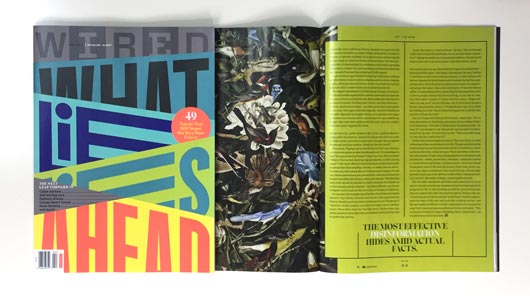
Demetricator in Wired

The February 2017 issue of Wired Magazine

My work Facebook Demetricator was discussed in the February 2017 issue of Wired Magazine. The article it’s a part of is titled “The Social Medium is the Message,” by Clive Thompson. In the wake of the US presidential election, Thompson writes about the cultural implications of social networks in the ways that they produce filter bubbles, enable fake news, and consolidate information access. When talking about tweaks that could be made to systems like Facebook, Thompson writes:

Let your imagination go wild and you can concoct even more aggressive, more ambitious reforms. Imagine if you got rid of all the markers of virality: no counts of likes on Facebook, retweets on Twitter, or upvotes on Reddit! Artist Ben Grosser created a playful browser plug-in called the Facebook Demetricator that does precisely this. It’s fascinating to try: Suddenly social media stops being a popularity contest. You start assessing posts based on what they say instead of because they racked up 23,000 reposts.

I recommend the full article! You can read the online version here.

Interview with We Make Money Not Art

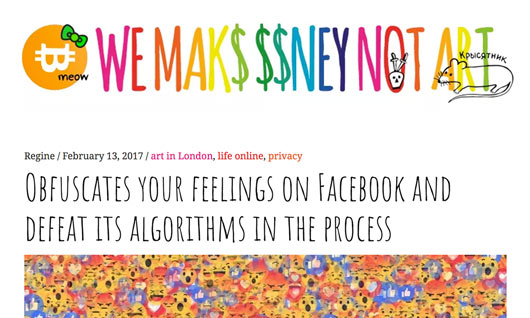
Interview with We Make Money Not Art

On the occasion of the Blinding Pleasures exhibition in London, I did an interview with Régine Debatty of We Make Money Not Art. We talked about Go Rando, how the Facebook News Feed shows you the world it thinks you want, resisting emotional surveillance, and more. It was really a pleasure to chat with her.

Go Rando Premieres at Arebyte Gallery in London

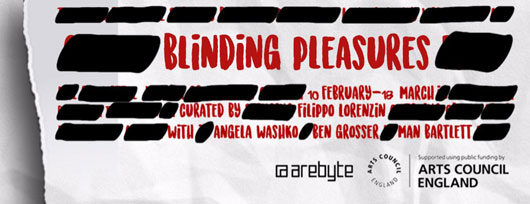
My work will be part of Blinding Pleasures at Arebyte Gallery in London

Next week I will launch a new work, titled Go Rando, as part of the exhibition Blinding Pleasures at Arebyte Gallery in London, UK. Curated by Filippo Lorenzin, Blinding Pleasures “… will study the dangers and potentials of a conscious use of the mechanisms behind the False Consensus effect and its marketing-driven son, the so-called “Filter Bubble”. … [Further, the exhibition] reflects on how people can critically take control over their inner psychological biases, disrupting the attempts of being misled by those who detain power on the platforms they use.” I’m pleased to be a part of this show with artists Angela Washko and Man Bartlett. Stay tuned for more about the new work!

Chapter Published in the 3D Additivist Cookbook

The 3D Additivist Cookbook

I’m happy to share that I have a chapter in the recently released 3D Additivist Cookbook. Edited by Morehshin Allahyari and Daniel Rourke and published by the Institute for Network Cultures, the cookbook “is a free compendium of imaginative, provocative works from over 100 world-leading artists, activists and theorists. The 3D Additivist Cookbook contains .obj and .stl files for the 3D printer, as well as critical and fictional texts, templates, recipes, (im)practical designs and methodologies for living in this most contradictory of times.” My piece is titled “Adding to Subtract: 3D Printer Recipes to Disrupt Our Desire for More,” and can be found on pp. 256-9 of the free open-access PDF. The whole thing is a large 460MB download—if you’d prefer, you can grab my text here (along w/ the cover page, contents, and editor introduction).

Interview about ScareMail for I SPY Documentary Film

Interview clip (w/ myself and William Binney) about ScareMail from “I SPY With My 5 Eyes” Film Documentary (watch the whole film)

I was very happy to be interviewed about ScareMail for a recently released online documentary film called “I SPY With My 5 Eyes,” about the impacts of global surveillance. Written and directed by Justin Pemberton, the film focuses on “the Five Eyes Alliance, a secretive, global intelligence arrangement between the governments of Australia, Canada, New Zealand, United Kingdom and United States. The alliance represents the largest surveillance program in human history.” The clip above has myself talking about ScareMail along with NSA whistleblower William Binney talking about the absurdity of NSA keyword searches. I highly recommend you watch the whole film, which is presented online in a novel interactive format.

Statactivism Workshop with Julien Prévieux at Julius Caesar

Stat-Activism Workshop with Julien Prévieux at Julius Caesar

Stat-Activism Workshop with Julien Prévieux at Julius Caesar

I’m pleased to be presenting my work as part of an upcoming workshop by Julien Prévieux at Julius Caesar this week. Titled Statactivism (after Prévieux’s book by the same name) the workshop will focus on the role of statistics in everyday life (both within and outside of software):

Statistics seem cold—inhumane measurements of the way in which we move about the world, tracking our patterns, needs, and daily interactions. Power is given to those who accumulate and analyze these numbers, and the concern of these quantified evaluations is shared by us all despite our position, career, or involvement with government. Julien Prévieux’s workshop will present research from his book Statactivism and its relationship to movement measurement which forms the basis of his upcoming exhibition at Julius Caesar.

This workshop is part of the events surrounding Julien’s upcoming solo exhibition at Julius Caesar. I had the good fortune of seeing this work at Centre Pompidou in Paris last year and highly recommend it! The workshop is space-limited, so please let me know if you’re interested in attending.

Talks, Workshops, and Panels in Lisbon, Berlin, and Paris

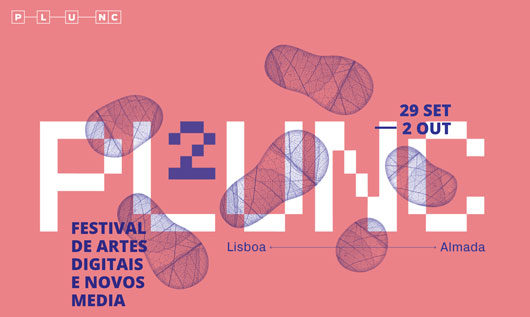
I'll be presenting talks and workshops at the PLUNC Festival in Lisbon, as well as talks in Berlin and Paris

I’ll be presenting at the PLUNC Festival in Lisbon, as well as talks in Berlin and Paris

I’m soon headed to Europe for a series of invited talks, workshops, and panels in Portugal, Germany, and France.

First is Portugal for the PLUNC Festival in Lisbon (which is showing my work Tracing You). With financial support from the United States Embassy and American Corners Portugal, I’ll give talks at the Universidade de Aveiro in Aveiro and the Instituto Superior Técnico at the Universidade de Lisboa in Lisbon. At the Festival itself I’ll give both a talk and a workshop, the latter titled Recomposing the Web: Writing Software to Investigate Software.

Next is Berlin, where I’ll join with Rachel Uwa from the School of Machines and Tatiana Bazzichelli from the Disruption Network Lab for a talk and panel on art as activism/disruption.

The last stop is Paris where I’ll give a talk for the Art, Media, and Technology program at Parsons Paris, as well as meet with collaborators.

Touching Software Discussed in Washington Post, FastCoDesign, and The Atlantic

GIF from Touching Software (House of Cards)

GIF from Touching Software (House of Cards)

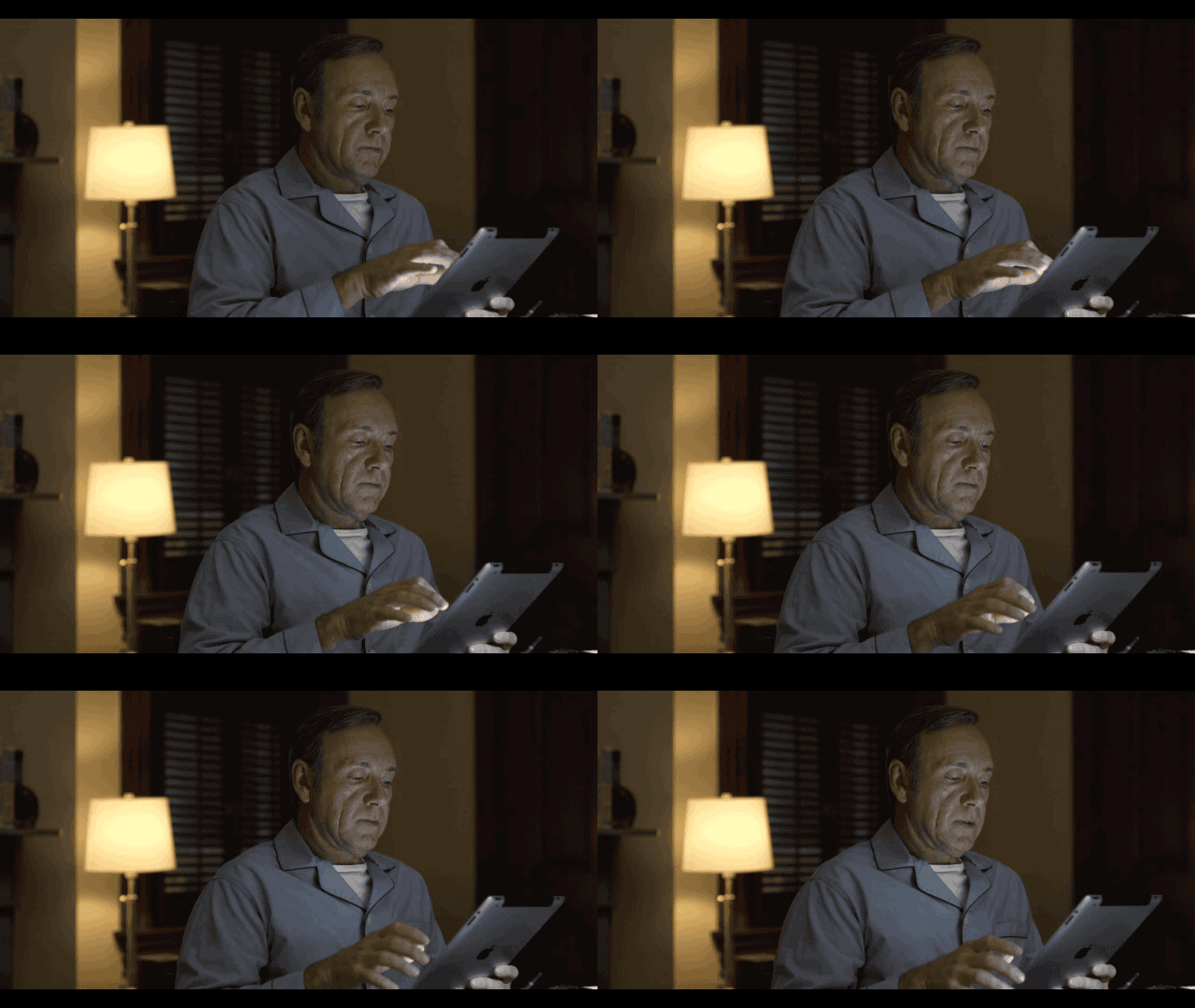
My work Touching Software (House of Cards) has been the subject of discussion in a number of publications, including:

I will update this list as more stories are published.